At 2 p.m. I was going to transform the spare room. I had empty boxes, a podcast queued up, and the smug energy of a woman who had already taken a “before” photo.
At 4 p.m. I was sitting on the floor in a ring of everything I own, eating crackers out of the sleeve, googling whether it would be easier to just move house.
The room was worse. Not slightly worse. Catastrophically worse, in the way only a half-emptied room can be, with the closet gutted onto the bed, three unlabeled piles that had lost their meaning, a bag of cables I refused to make a decision about, and a single sock I had been holding for eleven minutes.
Nobody warns you about that part. Every guide skips straight from “pull everything out” to a photo of a linen basket in soft light. The middle, the part where you have destroyed a functional room and replaced it with a landfill and a personality crisis, gets edited out entirely.
So let me name it: decluttering makes the room worse before it makes it better. Always. Every time. That is not a sign you are bad at this. That is the job.
The collapse isn’t failure, it’s just arithmetic
Here is what actually happens. You take a room that is messy but stable, where every object is at least parked somewhere, and you convert it into a room where nothing is parked anywhere. You have not added mess. You have made the existing mess visible, all at once, standing up.
And then you have to make four hundred decisions in a row.
That is the real ambush. The physical work is easy. Lifting a box is easy. What wrecks you is deciding, over and over, with no breaks, whether a thing is worth keeping, and about ninety minutes in your decision-making just quietly stops working. You start putting things in the “maybe” pile. Then you start putting things in a second maybe pile. Then you are holding a sock, thinking about the concept of socks.
The reward, meanwhile, arrives last. The calm empty shelf, the drawer that closes, the moment you can see the floor: all of that is at the end. So you are paying the full cost up front and collecting nothing until you finish. Of course people quit at hour two. Hour two is the worst possible ratio of pain to payoff in the entire project.
Which means the skill isn’t tidying. The skill is not being in that room at hour two.
Three rules that got me out of the floor-cracker phase
The first one changed everything: I never start a zone bigger than one hour. Not the spare room. One shelf of the spare room. One drawer. The corner behind the door. If I can’t finish it, put things back, and vacuum inside sixty minutes, it isn’t a zone, it’s a project, and projects get abandoned on the floor.
This feels pathetically small the first few times. Do it anyway. A finished shelf gives you the payoff on the same day you paid for it, and that is the only thing that gets you to come back next Saturday. A half-finished room gives you nothing but guilt every time you walk past. I learned this the same way I learned about the last ten percent of anything: the unfinished version costs more than never starting.
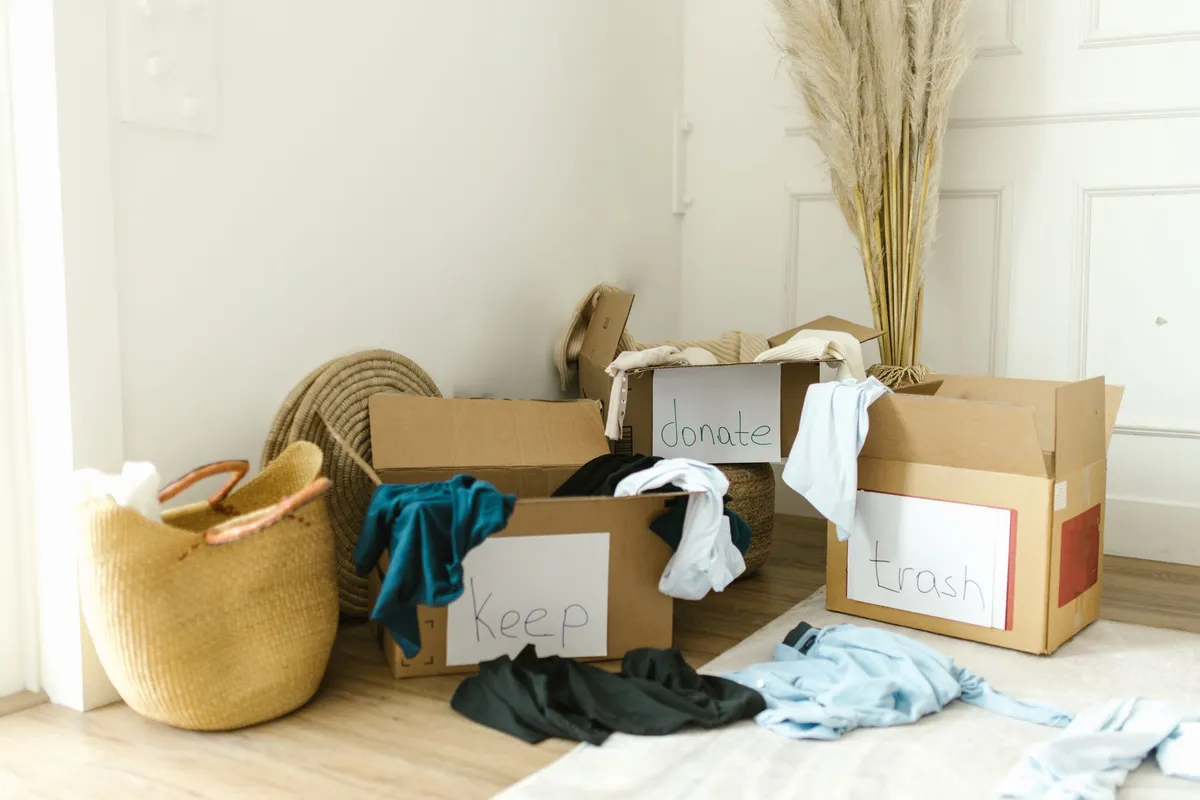
Second: work in containers you can close. Not piles. Piles have no edges, so they spread, merge and eventually become the room. I use three things with lids or handles, and that’s it. Keep, donate, bin. If a fourth pile starts forming, that’s the decision fatigue talking, and it’s my cue to stop for the day.
Third, and this is the one people skip: the donation bags go in the car the same day. Not the hallway. Not “by the door for now.” The hallway is where donations go to become furniture. Once a bag has sat there for four days, you start rummaging in it, and by day ten you have re-adopted half your own castoffs. In the car, sealed, boot closed. The drop-off can happen whenever, but the bag has to leave the house on the day you filled it.
For the stuff that makes you sad instead of decisive
Some objects don’t produce a yes or a no. They produce a feeling, and then you stand there holding a birthday card from someone you no longer speak to, and forty-five minutes of your afternoon evaporates.
Two things for those.
One, the box you don’t open. One box, taped, dated, shoved on top of the wardrobe. Anything you genuinely can’t decide on goes in, and you don’t touch it for three months. If you haven’t gone looking for a single thing inside it by then, you already know. Most people find they can donate it unopened, which is the entire point. Opening it restarts the argument.
Two, my rule for the sad items: sad is not the same as useful, and it’s not the same as loved either. If an object makes you feel heavy rather than warm, it doesn’t get to keep living in the drawer where you look for batteries. Take a photo of it if you need to. Then let it go, or put it in the taped box and let future-you, who is not currently sitting on a floor eating crackers, handle it.
The spare room took me four Saturdays in the end, one hour each, and the only week I genuinely dreaded was the first one. The one where I could still see the landfill version.
If your house looks worse right now, you didn’t break it. You just opened it. Close one container, take one bag to the car, and go do something else.
Frequently asked questions
How long should one decluttering session actually be?
An hour at most, including putting things back and cleaning the space. If you can't finish and reset the zone in that time, the zone is too big.
What do I do if I've already abandoned a half-sorted room?
Don't restart the whole thing. Pick one square meter of the existing chaos, finish it completely today, and let the rest sit until next time.
Is it okay to keep a maybe pile?
One, and only if it goes into a sealed, dated box you don't open for three months. A loose maybe pile just becomes a second version of the mess you started with.
Where should donation bags go if I can't get to a drop-off right away?
Straight into the car, tied shut. The hallway is where donation bags quietly turn back into your belongings.