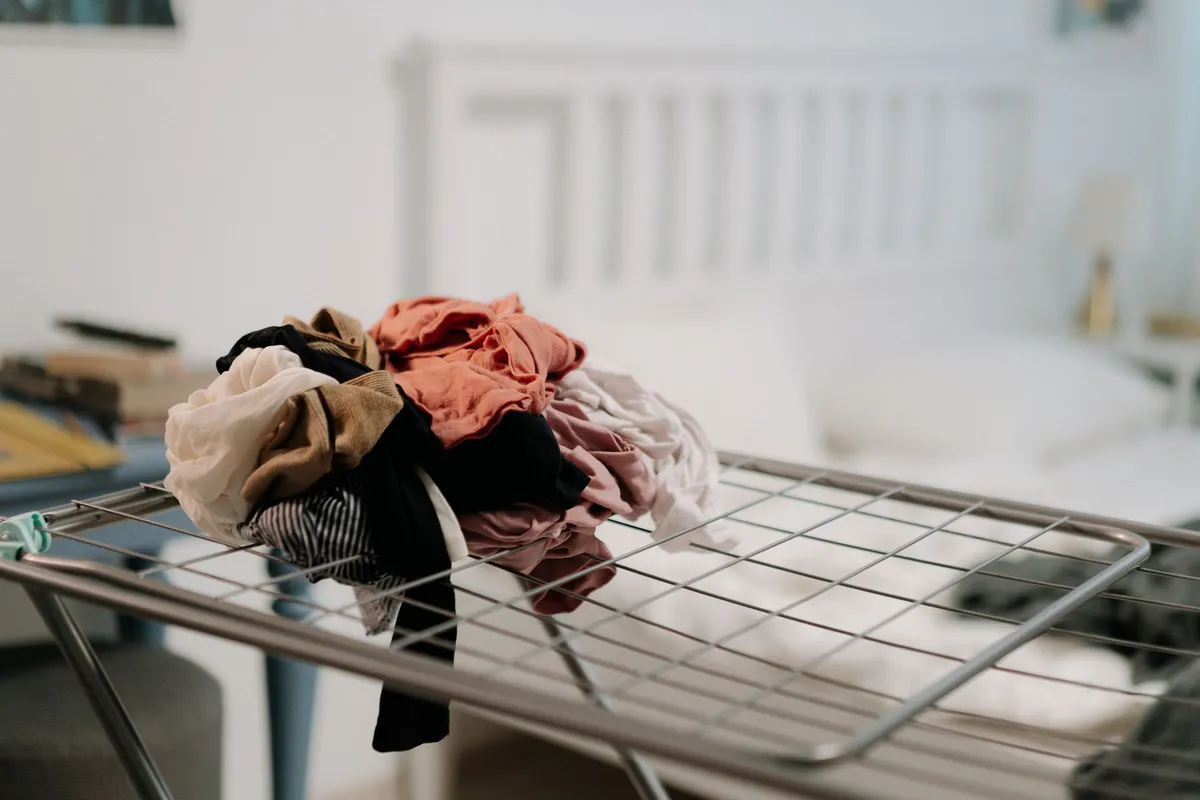
There is a chair in my bedroom that I have not sat on since the day I moved in. It currently holds a jumper I wore for forty minutes, two pairs of jeans in unresolved condition, a cardigan that belongs to a version of me who goes out, and a towel I keep meaning to have an opinion about.
I don’t call it a chair anymore. I call it the holding pen.
The pile is not static, either. It breathes. It gets shorter when I do laundry and taller when I’m tired, which means it’s less furniture than a mood ring for how my week is going.
And then someone announces they’re coming over.
You know the choreography. Forty minutes before the doorbell, I scoop the entire chair onto the bed, because the bed is out of sight and the chair is not. I fold three things properly, lose interest, and shove the rest into a heap with a blanket pulled over it like I’m hiding a body. Guests arrive. The flat looks like a person lives here on purpose. Everyone says something nice about the plant.
Then it’s 11 p.m., I want to get into bed, and the heap goes straight back onto the chair. Every single item. In roughly the same order. I have now moved the same jumper twice and made zero decisions about it.
That’s the part that finally got me. Not the mess. The fact that I was doing real physical labor, twice a week, to avoid one small act of thinking.
The pile isn’t laziness, it’s a missing category
Here is what I eventually worked out, and it reframed the whole thing for me: my laundry system offers exactly two options. Clean, which means it goes in the wardrobe. Dirty, which means it goes in the basket. That’s it. Two doors.
But most of my clothes, on most days, are in a third state. Worn for a few hours. Not sweaty. Not grubby. Not something I’d put back on a shelf next to freshly washed things, because I’d feel weird about it, and also because then I’d never know which of my black t-shirts had been through a Tuesday.
There is no door for that. So the clothes stand outside in the hallway of my bedroom and wait. On the chair.
Once I saw it that way, the chair stopped being evidence of a character flaw and started being useful data. It was marking, with great precision, the exact point where my system ran out. It’s the same energy as the junk drawer that quietly absorbs everything homeless: the drawer isn’t the problem, it’s the receipt for a problem. Every pile in a house is telling you something has no address.
Which also explains why tidying the chair never worked. I’d clear it on a Sunday, feel briefly like a competent adult, and by Wednesday it was fully restocked. I wasn’t failing at tidying. I was tidying a symptom. That’s the loop where decluttering somehow makes the mess worse, because you keep relocating objects that have nowhere to actually live.
What I did instead, and it cost about four pounds
I gave “worn once” an address.
Three hooks on the back of the bedroom door. That’s the whole intervention. One for the thing I wore today, one for the thing I wore yesterday and will probably wear again, one spare for coats or the gym stuff that’s drying. Jeans hang from the belt loop. Jumpers go over the hook by the shoulders, which is apparently wrong and which I’m going to keep doing.
The rule I gave myself is that a hook is not storage. It’s a waiting room with three seats. If something’s been hanging there for a week untouched, it has clearly made its decision: it either needs washing or I don’t actually like it. Both of those are answers.
What surprised me was how much lighter the mornings got. When you can see two outfits hanging at eye level, already vetted, already worn, already comfortable, you skip the whole standing-in-front-of-the-wardrobe stall. It turns out a lot of what I thought was a morning problem was really a last-night problem, which is the same thing I learned the hard way about how much of the morning gets decided the night before.
The chair is now a chair. I sit on it maybe once a week to put socks on. This is a genuinely absurd amount of satisfaction for four pounds of hardware.
The thirty-second rule, and when the pile means something else
The only habit part is this: when you take something off, you get thirty seconds to decide where it goes. Basket, hook, or hanger. No fourth option. Thirty seconds is short enough that you can’t dither and long enough that you can actually hang a pair of jeans, which takes about four.
If you miss the window, the item goes on the chair, fine, but it leaves in the morning with you. On your way out, one thing off the chair gets rehomed. The pile drains instead of compounding.
And here’s the tell worth watching. If the hooks are in place, the rule is easy, and the chair still fills up every week, the pile has stopped being about laundry. That version usually means you’re running on empty, that everything with a thirty-second cost is being deferred, and clothes are just the most visible ones. The chair was never lazy. It was tired, and honest about it.
Sometimes a pile of clothes is a filing error. Sometimes it’s a message. Either way, it’s worth reading before you fold it.
Frequently asked questions
How many times can you wear something before washing it?
It depends on the fabric and your day, but the useful question is simpler: would you be happy putting it back on a shelf with freshly washed clothes? If not, it belongs on the hook, not in the wardrobe.
What if I don't have a door to hang hooks on?
A slim valet stand, a wall peg rail, or even a couple of spare hangers on the end of your wardrobe rail does the same job. The point is a visible, limited space that isn't your clean storage.
Won't hanging clothes on hooks just create a new pile?
Only if you let the number of hooks grow. Cap it at two or three and the limit does the deciding for you, because a fourth item has nowhere to go and forces a call.
Does this work for a shared bedroom?
Better, actually. Give each person their own hooks so nobody is quietly resenting the other's jeans, and the chair stops being a joint negotiation.