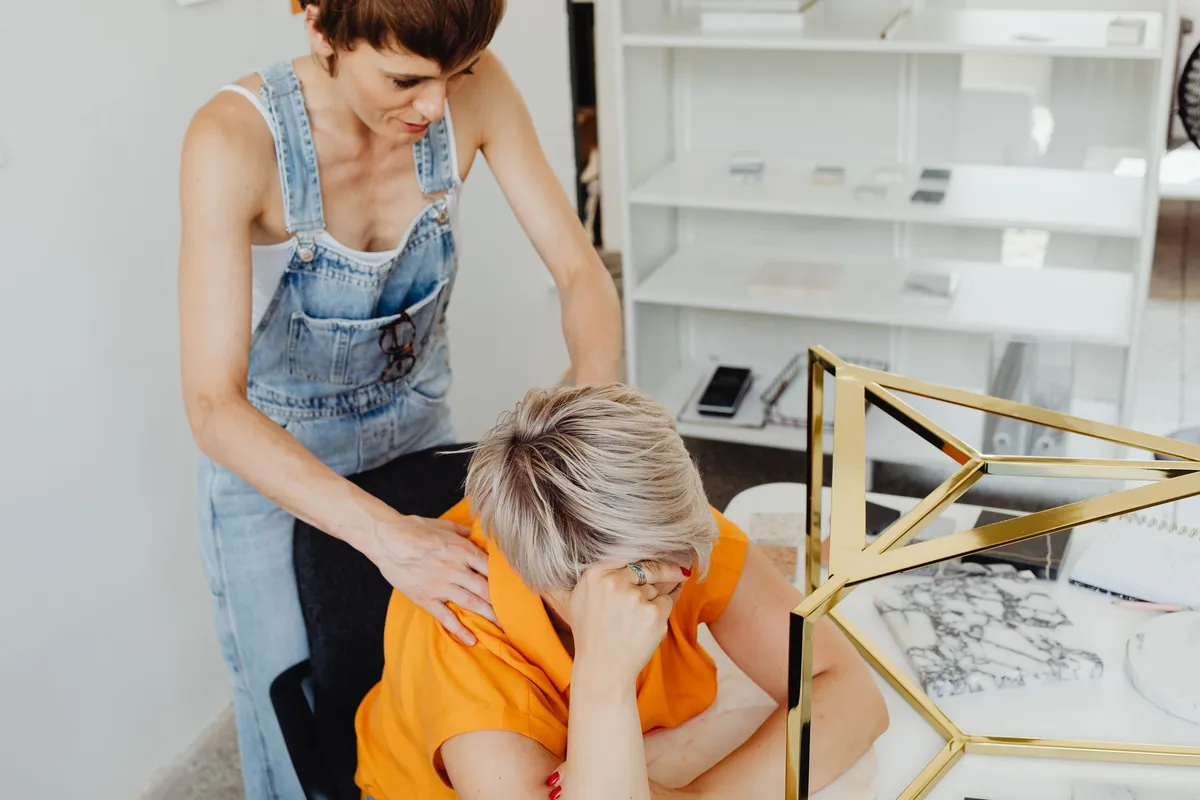
Someone puts a hand flat on your back mid-conversation and says, “Why are you braced?”
You have no idea what they mean. Then your shoulders drop, by what feels like four inches, and something in your neck resigns from its post.
You are sitting in a kitchen, drinking tea. Nobody is throwing anything. And your body has been holding a defensive position since, as far as anyone can reconstruct, Tuesday.
Worth knowing: stress is not only a mood. It is also something muscles do, while you answer emails or wait for a file to load. The jaw sets. The shoulders creep toward the ears like they are trying to protect something. And unless someone asks, the muscles rarely get checked.
“But I wasn’t even stressed”
People say that a lot. Often while their molars are pressed together hard enough to make a sound.
The lab version of this is surprisingly tidy. In a 1994 experiment, researchers attached sensors to the trapezius, the big muscle across the upper back and shoulders, in 62 women. Then they gave them mental arithmetic and a color-word test where the ink and the word disagree. No lifting, no typing marathon. Just thinking under pressure.
Both mental tests raised the electrical activity in the muscle compared with baseline. Blood pressure and the women’s own stress ratings moved in the same pattern. When the color-word test was added on top of a physical load, the muscle activity climbed further. The researchers took this as support for an old suspicion that psychological stress shows up as muscle tension even when the body is doing nothing physical at all.
A few honest limits. It was minutes of stress in a lab, in women only, more than thirty years ago. It cannot say what nine days of an unanswered message does to a neck.
And it does not clock the delay that many people describe: catching the brace at 11 a.m. and not feeling anything they would call stress until about four, when they are suddenly snappish and tired and convinced the day went badly. That timeline is everyday observation, not measurement. But it is a common one, and it suggests a cheap experiment. Check the muscles earlier in the day and see what they already know.
Not by meditating, necessarily. Twenty minutes of sitting still is, for a lot of people, a competitive sport they are losing.
Two seconds, no candles
The trick is to attach the check to things that already happen dozens of times a day, so there is nothing new to remember.
This is how habit researchers suggest building any small routine. A 2012 guide for family doctors defines habits as actions triggered automatically by a cue in the surroundings, and recommends picking a cue that already sits inside the daily routine and repeating the action there until it runs on its own.
So pick the cues. Every time you stand up. Every time the kettle boils. Every time you wash your hands. Yours might be getting in the car, closing a tab, or hearing one colleague’s specific laugh.
The check itself takes about as long as reading this sentence:
- Jaw. Is it clamped? Let the bottom teeth fall away from the top ones.
- Shoulders. Are they up? Let them go, and notice how far they drop, because the distance is the information.
- Breath. Where is it? If it is high and small, do one exhale that lasts longer than the inhale, like fogging a window.
The long exhale is borrowed from a 2023 trial with 108 adults, who did five minutes a day of either mindfulness meditation or one of three breathing exercises for a month. The exhale-focused breathing group, 30 people, showed the biggest improvement in mood and the largest drop in breathing rate. It was a small, exploratory study, and five minutes a day is not one breath by the kettle. Treat the single exhale as a nod in that direction, not a dose.
No app, no cushion, no dedicated time, no getting good at it. It can be done badly, while holding a kettle.
Most people quit right here, because nothing dramatic happens. The shoulders drop, things feel marginally better, and thirty seconds later they are back up by the ears. That feels like failure, though it isn’t. The point was never to stay relaxed, which is not a state adults get to live in. The point is that you found out at 11 a.m. something you would otherwise have discovered at four as a bad mood blamed on the wrong thing.
Twenty bad two-second checks beat one excellent twenty-minute session that happens once.
The fourth question nobody enjoys
Once catching the brace gets easy, add one more step. After the jaw and the shoulders and the breath, ask: what thought was sitting underneath that?
There is no study behind this part. It is just a useful question.
Most people expect the answer to be work. Deadlines, the inbox, the thing said in the meeting. Sometimes it is, and that is the laptop closed but the brain still running kind of bracing, which no amount of shoulder dropping fixes, because the problem is that the day never stopped.
But often the answer is a person. A conversation that is not being had. The message read and left unanswered for nine days. The friend you keep meaning to text. The disagreement that was technically resolved by both people going quiet, which resolves nothing and guarantees the same fight for the ninth time.
The shoulders know about all of it. The shoulders have opinions.
Seen that way, the tension is the posture of someone waiting for an unpleasant thing to happen, because an unpleasant thing has been scheduled by not dealing with it. Avoidance is not free. It bills you in the neck. And the conversation-shaped kind is the one you can do something about, usually in less time than was spent clenching over it.
If the tension is constant, severe, or comes with pain you cannot explain, that is a conversation for a doctor or a physiotherapist, not a kettle. This is about the ordinary daily brace, the one that dissolves the second someone touches your back and asks why.
Nobody is going to walk up and ask. That is the job now.
Jaw. Shoulders. Breath. Then the question you already know the answer to.
Run the two-second brace check at your cues
- Pick cues that already happen: standing up, the kettle boiling, washing your hands.
- Jaw: is it clamped? Let the bottom teeth fall away from the top ones.
- Shoulders: let them go and notice how far they drop. Breath: one long exhale.
- Once it gets easy, ask what thought was sitting underneath that.
It goes into your lab notebook on this device: a day counter, a daily tick and a note on how it went.
Sources
- Psychophysiological stress and EMG activity of the trapezius muscle. International Journal of Behavioral Medicine, 1994
- Making health habitual: the psychology of 'habit-formation' and general practice. British Journal of General Practice, 2012
- Brief structured respiration practices enhance mood and reduce physiological arousal. Cell Reports Medicine, 2023
Frequently asked questions
How often should you do the body check?
As often as the trigger you picked happens. Tying it to something that already occurs many times a day, like standing up or the kettle boiling, is what keeps it going; trying to remember it on its own rarely lasts.
The shoulders go straight back up. Is that doing it wrong?
No. Staying relaxed all day is not the goal. The goal is to notice the brace early enough to ask what is behind it.
Does one long exhale really do anything?
On its own it is mostly a pause. The research on exhale-focused breathing tested five minutes a day for a month, so a single slow breath is a small nod in that direction and a useful moment to check in.
When is tension more than everyday stress?
If it is constant, painful, or comes with numbness or headaches, have a doctor or a physiotherapist look at it rather than troubleshooting it alone.