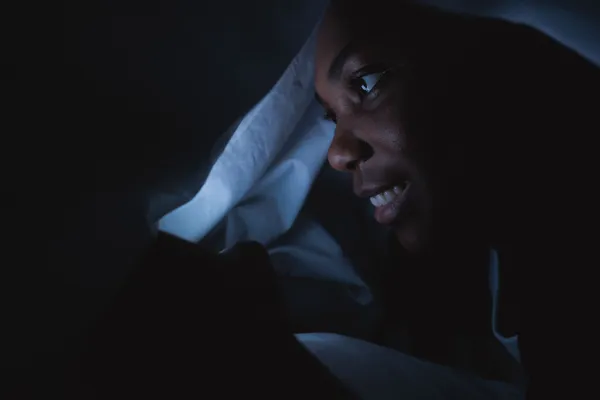
The screen glows, your eyes feel like sandpaper by four o’clock, and somewhere between the spreadsheet and the seventeenth open tab an ad promises that a pair of amber lenses will fix your eyes and your sleep.
It is a very good ad. It is also selling two completely different products inside one frame.
One promise is about your working day: the gritty, aching, six-hours-at-a-screen feeling. The other is about your night: the idea that the glow from your phone is keeping your body convinced it is still afternoon. Those are separate claims, tested in separate studies, and they deserve separate answers. Lumping them together is how a product with thin evidence on both halves ends up sounding like it has strong evidence overall.
So let us take them apart.
The eye-strain promise falls over first
This is the one most people buy for, and it is the one with the clearest answer.
The largest synthesis of the research is a 2023 Cochrane review of blue-light filtering spectacle lenses, which pulled together 17 randomized controlled trials covering 619 adults across six countries. The trials were small, some with as few as five participants, and short, with follow-up ranging from less than a day to five weeks.
On visual fatigue, the kind of tired, strained feeling you get at the end of a screen day, the review found there may be no difference between filtering lenses and ordinary clear ones in the short term. The certainty of that evidence is rated low, which is the review’s way of saying the finding could shift if better studies came along. One trial of 120 people reported a mean difference of 9.76 units on a fatigue score with a confidence interval running from -33.95 to 53.47, which is a statistical way of saying the result is compatible with a modest benefit, no benefit, or things being slightly worse. Two further studies, 46 people between them, also found nothing separating the groups.
On visual acuity, how sharply you actually see, the evidence is firmer and the answer is flatter: probably little or no effect, with a mean difference of exactly 0.00 logMAR in a study of 156 people. That one is rated moderate certainty, which is about as good as it gets in this field.
On daytime alertness, the honest answer is nobody knows. Two trials, 42 people total, very low certainty.
And then there is the part the marketing rarely mentions. The review notes that none of the included trials evaluated contrast sensitivity, color discrimination, discomfort glare, macular health, serum melatonin, or overall patient satisfaction. Not one. So if a product page tells you a lens protects the back of your eye over a lifetime of screen use, there is no trial in this review backing that up. It is not that the claim was tested and failed. It is that it has not been tested.
It is also worth knowing how shaky the underlying studies were. No trial was at low risk of bias across all seven domains the reviewers checked. Around 65 percent had a high risk of detection bias because the people assessing outcomes knew who was wearing what, 59 percent had a high risk of performance bias, and only about a third were pre-registered. The reviewers could not even run a meta-analysis, because the data were too patchy and the studies too different from each other.
None of which means your eyes are imagining things. They are tired. The trials just suggest the tint is not the lever. What is making them tired is almost certainly closer to home, and this next part is a practical rule of thumb rather than a research finding: hours of close focus, small text, a bright screen in a dim room, and the way people blink less when concentrating. Those are all free to change.
The sleep promise is real-ish, and also about five minutes long
The nighttime claim is more interesting, because at least the underlying idea has a mechanism behind it. Evening light does affect the body clock. The question is whether a pair of amber glasses, worn for a couple of hours before bed, moves your actual sleep.
The tightest test of that is a 2025 meta-analysis in Frontiers in Neurology, which pooled three double-blind randomized crossover trials. Crossover means each person wore both the amber lenses and a visually indistinguishable clear pair, with a washout in between, so they served as their own control and could not easily tell which was which. That is a good design. The problem is the size: 49 adults in total. Fourteen with chronic insomnia symptoms, fifteen recreational athletes, twenty healthy adults with no diagnosed sleep problem. Each trial ran about a week, with sleep measured by actigraphy, a wrist monitor that infers sleep from movement.
Pooled across all three, the glasses shortened time to fall asleep by about 4.9 minutes. Not statistically significant, with a confidence interval from 20 minutes faster to 10 minutes slower. Total sleep time went up by about 8.8 minutes. Also not significant, with an interval stretching from 35 minutes less to 53 minutes more. Sleep efficiency and time awake during the night barely budged.
Here is the fair reading, and it cuts both ways. Heterogeneity was zero, meaning all three trials pointed in the same direction: small, slightly favorable, indistinguishable from nothing. With 49 people, “not significant” means underpowered, not disproven. The confidence intervals are wide enough to contain a benefit you would notice and a small harm you would not.
The authors also flag something the ads will never tell you. The results split by who was in the study. The insomnia group showed a modest gain in total sleep time. The two healthy groups showed no actigraphic benefit at all, even though some of them reported feeling like they had slept better. Which is exactly what you would expect from people who did not have much room to improve, plus the warm glow of doing something about your sleep.
The Cochrane review found the same muddle from a different angle: across six trials with 148 participants, three reported better sleep scores with filtering lenses and three reported no difference. Its verdict on sleep quality was that it could not say whether the lenses are better or equivalent, at very low certainty.
And a detail that quietly undermines every study in the pile: none of the trials reported the actual light exposure at the eye, the intensity, the spectrum, the timing. So nobody can say whether a bigger dose of filtering would do more. There is no dose to compare.
Who might notice, and who is buying a very expensive ritual
If you are hoping a tint will stop your eyes hurting at four o’clock, the evidence says do not spend the money. That is the one place where the research is reasonably consistent and reasonably direct.
If you are hoping to protect your retina, there is nothing here. The trials did not look at macular health. An absence of evidence is not proof of uselessness, but it is also not a reason to pay a premium.
If you are a healthy sleeper who falls asleep fine, the pooled effect you are shopping for is somewhere around five to nine minutes, and it could not be told apart from zero. You will probably notice something, because people usually do when they start a bedtime ritual with props. Whether the lens is doing it is another question entirely, and the clear-lens control groups exist precisely because of that.
If you genuinely struggle to sleep most nights, the one faint hint of benefit in that meta-analysis came from the insomnia group, and that is a clinical situation rather than a shopping problem. Persistent insomnia is worth a conversation with a doctor, not a checkout page.
On safety, the Cochrane review is reassuring in a mildly funny way. Reported side effects with filtering lenses included headache, discomfort, lower mood and increased depressive symptoms, but they were infrequent, temporary and generally mild, and the reviewers thought most of them came from wearing glasses at all rather than the filter. The clear control lenses also made some people uncomfortable, and produced the odd case of unusually elevated mood. Glasses are glasses.
If you already own a pair, find them comfortable, and they have become the signal that the working day is over, keep wearing them. A reliable cue to stop scrolling is worth something, even if the lens is doing none of the work. Just be clear with yourself about which part is the ritual.
Run the free version of the experiment first
Before you buy anything, test the variable the trials could not control: how much light you are actually giving yourself, and when.
For seven nights, keep your wake time fixed. That one matters more than almost anything else, and a wake-time planner will do the arithmetic backwards to a sensible bedtime for you. For the first three nights, carry on exactly as you normally do. For the last four, keep the screens if you want them, but drop the room lights to the lowest level you can still function in and put your phone brightness as low as you can read it, starting about two hours before bed.
Each morning, write down two numbers: roughly how long it took you to fall asleep, and how your eyes felt by late afternoon the previous day, on a scale of one to five. Twenty seconds, in your phone notes.
Then apply the threshold the research hands you. The pooled estimate for the glasses was five to nine minutes, and it could not be distinguished from zero. So if dimming your evening does not move your sleep by more than about ten minutes, a tinted lens is very unlikely to do better. And if it does move it by more than that, you have just found your answer for free.
If the numbers barely wobble but you are still lying there at 2 a.m., the problem is probably not photons at all, and the 3 a.m. wake-up has its own set of causes.
Blue-light glasses are not a scam. They are a very small answer to a question most people have not actually asked yet, which is what their evening is made of.
Test your evening light before buying any lenses
- Keep one fixed wake time for seven days, no exceptions
- Nights 1-3: evening as usual. Nights 4-7: lights and phone brightness as low as readable
- Each morning log two numbers: minutes to fall asleep, and yesterday's 4 p.m. eye comfort (1-5)
- If nothing shifts by more than ten minutes, a tinted lens is unlikely to do better
It goes into your lab notebook on this device: a day counter, a daily tick and a note on how it went.
Sources
- Blue-light filtering spectacle lenses for visual performance, sleep, and macular health in adults. Cochrane Database of Systematic Reviews (Cochrane Eyes and Vision), 2023
- Efficacy of blue-light blocking glasses on actigraphic sleep outcomes: a systematic review and meta-analysis of randomized controlled crossover trials. Frontiers in Neurology, 2025