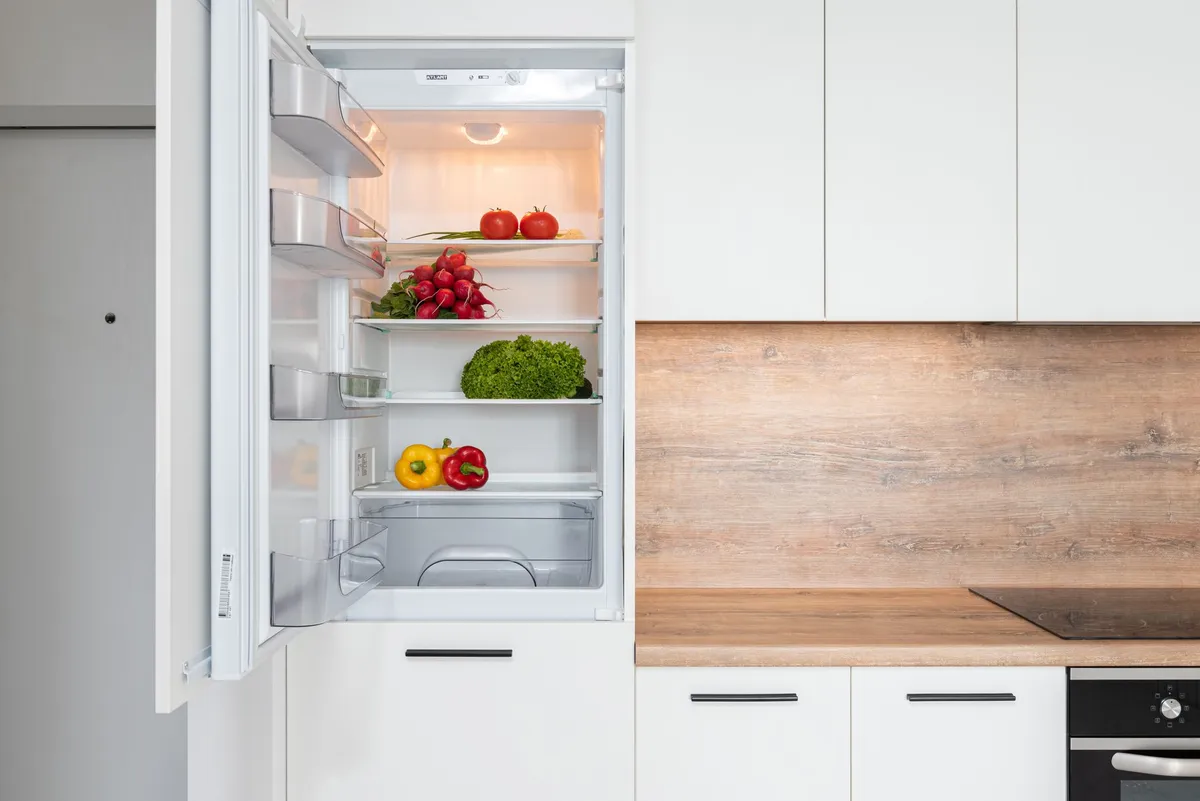
The fridge door is open at 6:40 and you’re looking at three half-used jars, a bag of spinach going soft at the edges, and half a block of cheese. You close the door. You order food anyway.
Then you eat it on the couch while the spinach gives up in the drawer.
This is the strange arithmetic of a weeknight. The fridge is objectively full. Your brain files an honest report: there is nothing to eat. Both things are true at once, and the gap between them is where forty dollars of delivery lives.
You didn’t buy dinner, you bought possibilities
What follows is an argument rather than a finding, so take it as a reframing you can test rather than a law of nature.
Most of what’s in your fridge is potential rather than food. A bag of spinach stands in for about nine dinners that have not been chosen. Chicken thighs are a question. Half a lime is a hint. Everything in there needs a second step before it becomes something you can put on a plate, and at 6:40 you do not have a second step in you.
You shopped the way an optimist shops: ingredients, good ones, bought by a version of you who had time, who had just eaten lunch, who imagined a Tuesday with music on and nothing urgent in the inbox. That person is not home right now. The person standing at the fridge wants to be told what dinner is, not asked.
So the fridge turns into a storage unit for guilt. Every shelf holds an unpaid debt. Opening it feels less like shopping and more like reviewing your own unfinished work, which is roughly as appetizing as it sounds. And the fuller it gets, the louder it is, because now there are twelve possibilities and still no decision. That part is not just a feeling. A meta-analysis of 99 choice experiments with 7,202 participants found that more options turn into fewer decisions mainly when the choice is hard to compare, when you are unsure what you want, and when you are trying to spend as little effort as possible. A tired person in front of a full fridge is all three at once. Those experiments were about shop shelves, not kitchens, but the ingredients are the same.
Notice what the takeout solved. Hunger was never the hard part; the decision was. Someone else named the dish, and you were allowed to just want it.
The planning that helps is smaller than you think
The standard advice at this point is to meal-plan the week. Seven dinners, one spreadsheet, one enormous shop. It works beautifully for about eleven days, and then a Thursday happens.
There is decent evidence that planning and eating well travel together, and it’s worth being precise about what it says. A 2017 study of 40,554 French adults in the NutriNet-Santé cohort found that 57 percent of people planned meals at least occasionally, and that planners were somewhat more likely to be in the top quartile for food variety and for sticking to national nutrition guidelines. The effects were real but modest, and the study was cross-sectional, which means nobody can tell you which way the arrow points. People who already cook happily may well be the type to plan. The participants were web-recruited volunteers who were self-reporting, including their own weight and height. Call it a correlation rather than a prescription.
But the detail worth stealing is in the definition. Planning there meant thinking ahead about what you’d eat over the next few days. Not seven days. A few. The thing associated with eating better was a short horizon, which happens to be the only horizon a real week supports.
Three dinners, one shelf, one raid night
So shrink it. Instead of planning seven dinners, name three, and let the rest of the week stay vague on purpose.
- Name three dinners, with days attached. Not “chicken,” not “something with the spinach.” Write “Tuesday: pasta with sausage and spinach” on the fridge door where you’ll see it while you’re standing there deciding. A dish with a day on it is a decision you already made. A bag of spinach is homework.
- Keep an eat-this-first shelf at eye level. Opened jars, the soft produce, the leftovers from Sunday. One shelf, front and center, no digging. If it’s on that shelf, it has about three days to live and everyone knows it.
- Book one raid night a week. The rule is simple: use what’s open, no shopping allowed, standards suspended. Eggs on toast with the last of the cheese counts. Rice with whatever’s on the eat-first shelf counts. This is the night that clears the backlog, and it is the only night where “weird” is the point.
- Leave the other nights undecided. Takeout, leftovers, cereal at the sink. If you don’t plan them, you can’t fail them.
Three named dinners also means a smaller shop, which means less potential in the drawer, which means less guilt when you open the door. The fridge stops being an exam.
If naming three feels like more work than it is, it’s usually because you’re trying to invent new ones. You don’t need new ones. You need the same six dinners you already know how to cook, rotated so they don’t land twice in a row, which is the entire job of the dinner rotation builder.
Try it for one week and watch what you’re actually tired of
Sunday, or whenever your week starts, write three dinners on the fridge door with the day next to each one. Load the eat-first shelf. Pick your raid night. That’s the experiment.
By Thursday you’ll know something useful. Either the food was the problem, and three decisions fixed it, or the food was never the problem and you’re mostly tired, in which case the honest move is a raid-night omelet and an early bedtime rather than a better system. Both results are worth having, and neither requires a spreadsheet.
A full fridge isn’t dinner. Three names on a door is.
Show as a table
| Non-planners | Meal planners | |
|---|---|---|
| Just before the meal | 30.48 | 11.87 |
| During the day | 41.72 | 26.27 |
| The day before | 21.46 | 25.63 |
| A few days before | 6.02 | 28.54 |
| A week before | 0.32 | 7.69 |
Name three dinners and leave the rest vague
- Write three dinners on the fridge door, each with a day next to it
- Load an eat-this-first shelf at eye level: opened jars, soft produce, leftovers
- Book one raid night: use what's open, no shopping, standards suspended
- Leave the other nights genuinely undecided
It goes into your lab notebook on this device: a day counter, a daily tick and a note on how it went.
Sources
- Meal planning is associated with food variety, diet quality and body weight status in a large sample of French adults. International Journal of Behavioral Nutrition and Physical Activity, 2017
- Choice overload: a conceptual review and meta-analysis. Journal of Consumer Psychology, 2015