You own four notebooks and a task app with color-coded tags, and last Tuesday you spent thirty-five minutes moving “sort out insurance renewal” from one notebook to another. Then you made a coffee and felt, briefly, like a competent adult.
The insurance renewal remains unsorted.
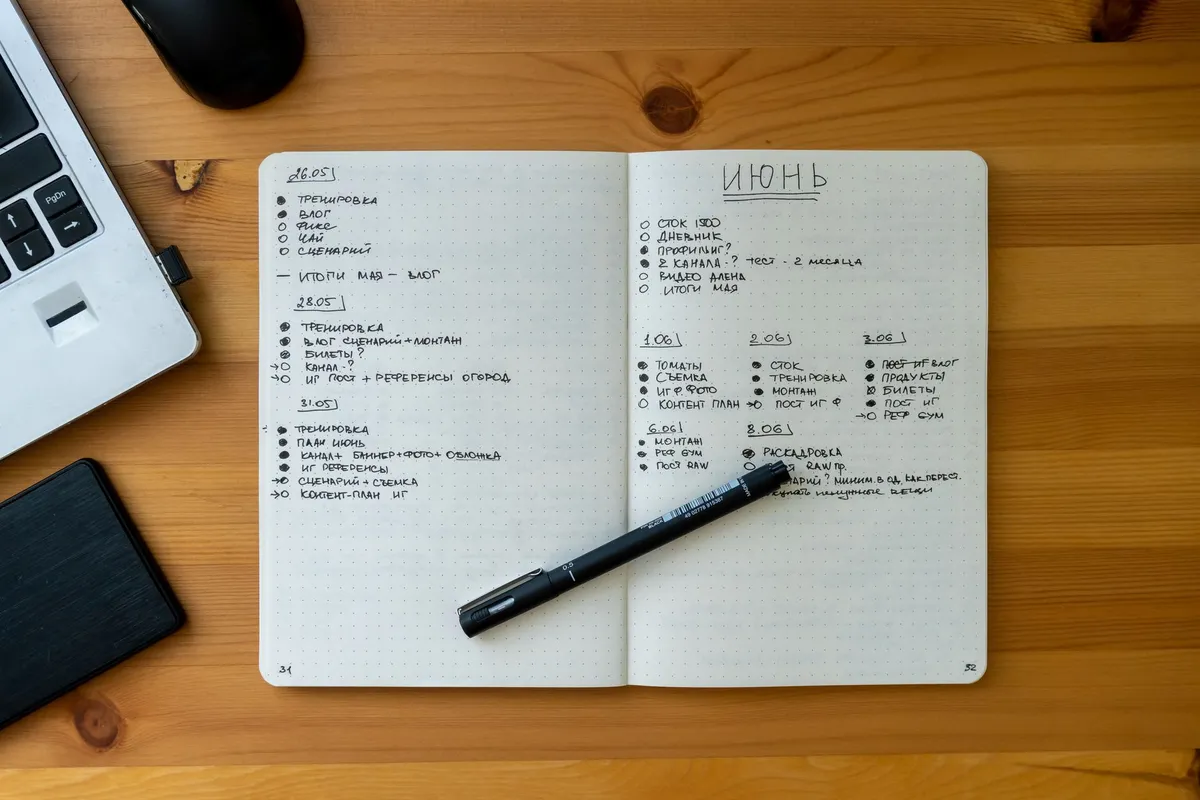
Count the drafts some week, if you dare. It can reach eleven: eleven versions of the same list, the same four items migrating from page to page like geese with nowhere better to be. The handwriting gets neater each time. The tasks get no closer to done.
There is a very specific pleasure in a fresh page. The pen that works, the first line sitting straight, the feeling that this version of the list is the real one and the last four were warm-ups. For about ninety seconds the day looks manageable. The fog in your head has edges now. It registers in the body as progress, a warm flicker of having handled something.
And then it is 6 p.m. and the same four items are still breathing.
The fresh page works, which is the problem
The obvious suspects are the tools. Wrong system, wrong app, wrong notebook size. So you try the tiny pocket one and the big satisfying one and the app with the swipe gestures, and each of them works beautifully for one afternoon.
The relief is real, though, and there is research on where it comes from. In a series of lab studies on unfinished goals, people with an unfulfilled goal on their minds were dogged by intrusive thoughts during an unrelated task. When they were allowed to make a specific plan for the goal, the intrusions stopped, even though nothing had been done yet. The authors’ reading was that a plan lets the mind stand down until the appointed time.
That is a generous feature with an obvious loophole. Writing the list delivers some calm before any work has happened. One caveat from the same paper matters here: the quiet tracked how earnest the plan was, and the people who went on to carry out their plans were the ones whose intrusions disappeared. Whether a fifth neat copy of the same four nouns counts as an earnest plan was not tested. The fact that the calm wears off by six suggests an answer.
Everything you keep rewriting is a noun
Look at what is on the page.
“Insurance renewal.” “Dentist.” “Tax stuff.” “Mom’s birthday.” “Website.”
Those are topics, not tasks. They are the names of entire rooms you do not want to walk into, written on a line as if they were chores. You cannot do a topic. You can only worry about it, and then rewrite it somewhere nicer.
Compare: “open the renewal email and write down the policy number.” That is a thing a body can perform. It has a verb, a beginning, and a clear moment where it stops. Hands know what to do with it. Hands have no idea what to do with “insurance renewal,” so they pick up a pen instead, the one tool that lets a person look busy while deciding nothing.
A set of experiments points the same way. In a 2008 study of how people think about tasks, participants were asked to complete a questionnaire and send it back by email within three weeks. Some versions of the questionnaire were designed to make people think in concrete terms, others in abstract terms. The concrete groups procrastinated less. The effect did not depend on how attractive, important or difficult the task seemed. It was a questionnaire, not a tax return, but the direction is hard to miss: the same job gets done sooner when it is pictured concretely.
Switch the list to verbs and a strange thing tends to happen. The actual actions turn out to be tiny and slightly stupid. “Dentist” can ride along on lists for five weeks. “Call the dentist and ask for any Thursday” is over before the hold music gets going. It is the same lopsided ratio as the email avoided for three weeks that takes four minutes.
One list, three lines, verbs first
So the fix is less a system than a rule about grammar. It fits on the back of the notebook you were about to start over in:
- One list, written once. No second draft.
- Three lines at most. A rule of thumb, not a finding. Three lines cannot be rewritten in a pleasing way, which is the point. Finish early and go fishing for a fourth.
- Every line starts with a verb a body recognizes: call, open, print, ask, send, find.
- No verb, no entry. If the verb will not come, the task is not ready, and it goes in one ugly dump file with no headings, no color and no order. A drawer, not a display case.
One kind of item will resist even this. The rewriting tends to spike when a task is vague, and again when a task is slightly humiliating. The email admitting something was forgotten. The call where someone will hear that it lapsed. The message to a friend who has waited so long that the reply now needs a preamble.
A better list does not get those done. Naming the wince does. When your hand reaches for a clean page, ask what exactly is being dreaded. Often the answer is not the task at all. It is looking like someone who let this slide. Which, fine. It did slide. The list was never going to fix that. It was only going to keep you warm in the meantime, the same way waiting to feel ready does.
So the next time your hand goes for the fresh page, write the first physical action instead. One line, starting with a verb. Then do it before the pen is back in the drawer.
A list you rewrite is a list you are hiding in. A list you can’t rewrite is one you have to finish.
Write one list, three lines, verbs first
- Write one list, once, with no second draft and three lines at most.
- Start every line with a verb a body recognizes: call, open, print, ask, send, find.
- No verb, no entry: park unready tasks in one ugly dump file with no headings or order.
- When your hand reaches for a fresh page, write the first physical action and do it.
It goes into your lab notebook on this device: a day counter, a daily tick and a note on how it went.
Sources
- Consider it done! Plan making can eliminate the cognitive effects of unfulfilled goals. Journal of Personality and Social Psychology, 2011
- Construal Level and Procrastination. Psychological Science, 2008